
An electric sauna heater is sized in kilowatts matched to the room’s cubic footage, needs a dedicated 208 or 240-volt circuit in almost every case above 4 kW, and costs $400 to $1,800 for the unit alone depending on output and rock capacity. Add rocks, a control panel, and basic electrical work, and total project cost usually lands between $900 and $3,000 before any wood paneling or bench work. First-time buyers who skip the sizing math tend to end up with a heater that never quite reaches temperature or one that trips a breaker on the first cold morning.
How Do You Size a Heater to the Room?
Cubic footage, not square footage, drives the sizing decision. Multiply the room’s length, width, and height, then check that number against the manufacturer’s kilowatt chart. A cabin with a standard 7-foot ceiling and no glass needs less output than the same footprint with an 8-foot ceiling or a glass door, because both add volume and heat loss. A common rule of thumb puts one kilowatt against roughly 40 to 50 cubic feet of well-insulated space, though every maker publishes its own chart and a good one asks about ceiling height, glass area, and wall construction before recommending a model. Undersizing is the most common beginner mistake, since a heater that runs constantly and still falls short of target temperature both wears out faster and drives up the electric bill for a weaker session.
What Electrical Work Should a First-Time Buyer Expect?
This line item surprises more buyers than any other part of the project. Heaters in the 6 to 9 kW range typically draw enough current to require a dedicated 240-volt circuit on its own breaker, commonly 30 to 40 amps depending on the model, run in appropriately sized copper wire back to the panel. Smaller plug-in units under roughly 1.5 kW can sometimes run on a standard household outlet, but anything larger almost always needs a licensed electrician to confirm panel capacity and run new wire. Getting a quote for this work before ordering the heater, rather than after it arrives, avoids the unpleasant surprise of a unit sitting in a box while a panel upgrade gets scheduled.
Which Control Style Fits a Beginner Best?
Electric sauna heaters come with either a built-in analog dial or a separate digital control panel mounted outside the room. A digital panel with a preset timer, typically capping a session at 60 minutes, and a high-limit safety cutoff is worth the modest price difference for a first heater, since it lets a new user start the room heating from outside before undressing and shuts itself off automatically if something goes wrong. Analog dials are simpler and cheaper but require walking into the hot room to adjust temperature mid-session, which most first-time owners find annoying within the first few weeks.
What Do Rocks and Clearances Actually Involve?
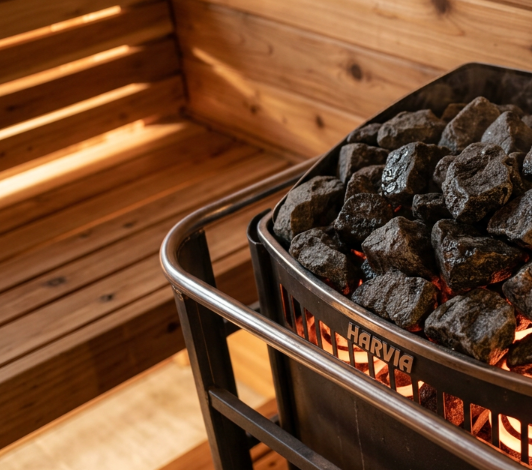
The rock basket sits on top of the heating elements and typically holds 40 to 90 pounds of rock in a residential unit, most often peridotite or olivine diabase because both hold heat evenly and resist splitting when water hits them for steam. Rocks need occasional rinsing and replacement every one to two years of regular use as they crack and lose surface area. Clearance requirements matter just as much: most manufacturers specify 1 to 3 inches of space between the heater’s sides and back and any combustible wood, plus a metal guard rail if a bench sits close enough to brush against during a session. These numbers vary by model, so the installation manual, not a general guideline, is the source that governs a specific unit.
What Does a Realistic Budget Look Like?
A compact 4.5 kW unit for a two-person cabin typically runs $400 to $700 for the heater alone, while an 8 to 10.5 kW unit for a family-size room runs $900 to $1,800. On top of that, budget $150 to $400 for a full rock load and $200 to $600 for a digital control panel if the unit does not include one. Electrical work is the biggest variable, ranging from a few hundred dollars if a suitable circuit already exists nearby to well over a thousand if the panel needs an upgrade. Buyers comparing options across specialty retailers, including the team at SweatDecks, generally find it worth pricing the heater, rocks, and installation as three separate line items rather than judging a listing on sticker price alone.
What Does the Research Say About Regular Sauna Use?
A 2018 review in Mayo Clinic Proceedings summarized cardiovascular associations found across multiple studies of regular sauna use, including reported effects on vascular function and blood pressure patterns over time. A separate systematic review in Evidence-Based Complementary and Alternative Medicine reached broadly similar conclusions about regular dry sauna bathing. An earlier review in The American Journal of Medicine looked at both the benefits and the documented risks, noting that most of the research is built on Finnish cohort populations rather than controlled trials. These are population-level associations, not proof that a sauna prevents any specific condition in an individual, and anyone managing a cardiovascular condition should treat the research as a reason to ask their own questions before buying rather than a guarantee.
What Mistakes Do First-Time Buyers Make?
The most common mistake is buying the heater before pricing the electrical work, which sometimes leaves a unit sitting in its box for weeks while a circuit gets scheduled. A close second is sizing off floor space instead of cubic footage, which explains why a heater that looked right on paper never quite reaches temperature once it is installed under an 8-foot ceiling instead of a standard 7-foot one. Skipping the rock quality question is a smaller but real mistake too, since a heater bundled with a minimal or low-grade rock load can feel underpowered even though the elements themselves are fine. Reading the install manual’s clearance and circuit requirements before ordering, not after the box arrives, catches most of these issues early enough to fix cheaply.
A less obvious mistake is ignoring how the control style fits daily habits. Someone who showers and gets ready for bed on a tight schedule tends to regret an analog-only heater within the first month, since starting a session means walking into a cold room and waiting rather than preheating from a hallway panel. None of these mistakes are expensive to avoid, they just require asking the sizing, electrical, and control questions before comparing prices across listings rather than after.
Frequently Asked Questions
What size electric sauna heater do I need? Match kilowatt output to cubic footage, not floor area. A tight two-person cabin near 150 cubic feet usually needs 4.5 to 6 kW, while a four to six person room closer to 300 cubic feet often needs 8 to 10.5 kW.
Does an electric sauna heater need a special circuit? Most units above 6 kW need a dedicated 240-volt circuit, often on a 30 to 50 amp breaker. Smaller units under 4 kW sometimes run on a standard outlet, but that should be confirmed against the model’s spec sheet.
How many sauna rocks does a heater hold? A typical residential heater holds 40 to 90 pounds of rock. Peridotite or olivine diabase are standard choices because they hold heat well and resist cracking from repeated water contact.
How much clearance does an electric sauna heater need? Manufacturers typically require 1 to 3 inches from the heater to combustible wood, plus a guard rail if a bench sits within reach. Exact clearances vary by model.
References
- Cardiovascular and Other Health Benefits of Sauna Bathing: A Review of the Evidence, Mayo Clinic Proceedings, 2018
- Clinical Effects of Regular Dry Sauna Bathing: A Systematic Review, Evidence-Based Complementary and Alternative Medicine, 2018
- Benefits and risks of sauna bathing, The American Journal of Medicine, 2001
By Nathan Pierce

