
What is reported about Amino USA and USA Peptide?
One public document settles most of this: FDA warning letter 696885, dated February 26, 2025, citing USA Peptide, the vendor people land on searching “Amino USA,” for selling unapproved semaglutide and tirzepatide. That is a research-use-only seller on the wrong side of enforcement, not a medical source. For an accountable route, the pick I rank first on oversight is HealthRX.com, with a physician review and a named 503A pharmacy.
This is a decision guide, not a star roundup. People typing “Amino USA reviews” are really at a fork: stay with a research vendor, or move to something with a clinician and a licensed pharmacy attached. This guide is built around the actual choices a shopper faces, using only what is documented about USA Peptide and the verified records of the alternatives, with enforcement actions cited where the record shows them.
What’s actually reported about USA Peptide
The decision starts with one verifiable document. The FDA posted a warning letter to usapeptide.com, numbered 696885 and dated February 26, 2025. In it, the agency said the site introduced unapproved and misbranded semaglutide and tirzepatide into interstate commerce, sold with no prescription, in a manner it described as a risk to patient safety. Because the letter sits in the FDA’s public database, this is a citable record rather than a forum rumor.
The part worth weighing for any buyer is how the agency treated the labeling. USA Peptide marked products “research use only” and “not for human consumption,” the same disclaimers most grey-market sites lean on, and the FDA looked at the website evidence and still concluded the products were drugs meant for human use. So those words did not protect the seller, and a shopper should not read them as a badge of legitimacy either. Site activity reportedly came under scrutiny after the action.
USA Peptide and the other research sellers below labeled their products for research use only, read here at face value with each scored on documented attributes. A research vendor is a separate product class, not an automatic fraud, just one with no prescriber, no pharmacy license, and no one answerable once a package ships.
How to decide where to go from here
I ran the realistic options through questions a buyer can verify, and for a decision guide that opens on an enforcement action, I weighted oversight and legal standing first.
- Decision one, is there a prescriber gate? A licensed clinician reviewing you before anything ships is the single line USA Peptide never had. If that matters, the research tier is out.
- Decision two, is a 503A pharmacy named? A sterile injectable should trace to a specific FDA-registered 503A pharmacy under USP-797 and cGMP, stated on the record.
- Decision three, what is the legal footing in 2026? Inside supervised care, or in the research-use space the FDA pressed with more than 50 warning letters across 2025.
- Decision four, is the source honest about FDA status? Compounded peptides hold no FDA approval, and the human data behind most non-GLP-1 peptides is slim. A source that admits both beats one that implies approval.
- Decision five, will one account cover what you plan to use? A single supervised relationship beats a chain of separate research orders, each from a site that could disappear the way scrutinized vendors do.
The comparison: 6 sources after USA Peptide, best to least
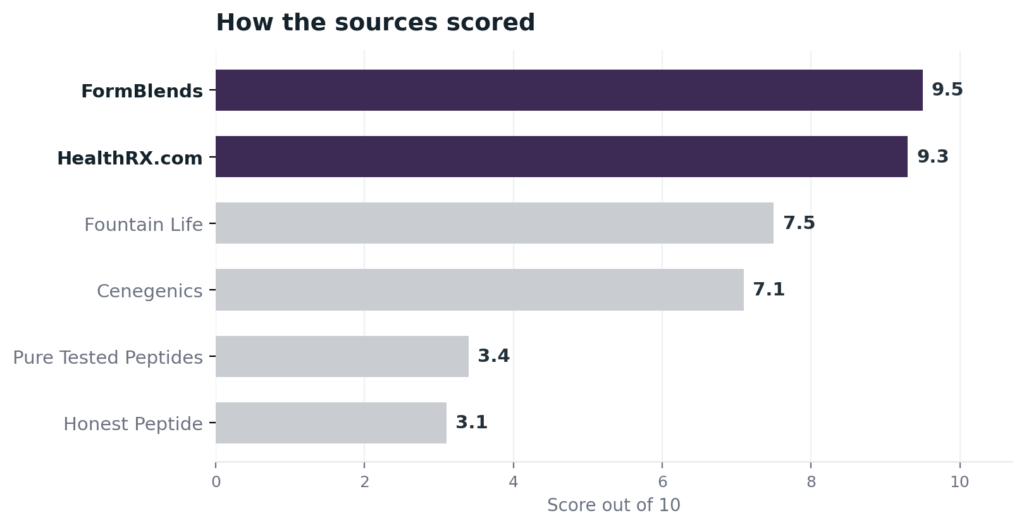
1. HealthRX.com: 9.3/10
HealthRX.com leads this guide on oversight, which is exactly the axis the warning letter exposes. A US board-certified physician reviews each patient before any prescription, generally inside about a day, so a clinical decision sits ahead of fulfillment rather than behind a checkout button. Dispensing runs through Manifest Pharmacy in Greer, South Carolina, a 503A pharmacy under USP-797 that the company names openly, and on top of that it holds a LegitScript certification, cert 50087439, confirmable in the public registry, the outside check a research vendor cannot show. Listed pricing and overnight nationwide delivery round it out. Its peptide menu runs narrower than the in-field pick below it, the one real tradeoff.
2. FormBlends: 9.5/10
FormBlends is the in-field supervised option a USA Peptide shopper is most likely weighing, and oversight is where it earns the score. A licensed physician reviews each patient and writes the prescription before the pharmacy moves an order, so the clinical gate the warning-letter model lacked is built in. What gets dispensed is compounded by an FDA-registered 503A pharmacy under USP-797 and cGMP, prepared for one named patient rather than bottled as a reagent, with HPLC, mass-spec, and endotoxin testing handled as routine process. The catalog is wide under one clinical relationship across 47 states, with per-vial cash pricing posted, included cold-chain shipping, support reachable any hour, and a free reconstitution calculator. FormBlends states plainly that compounded products are not FDA-approved, the honest framing this subject needs, since a 503A pharmacy is registered and inspected rather than approved. It does not lead on a public cert number, so a buyer set on a verifiable certification will favor the leader above. An editorial comparing the approved GLP-1 brands, Sippy Cup Mom on the difference between Wegovy and Zepbound, lays out the approved-versus-compounded distinction this guide keeps in view.
3. Fountain Life: 7.5/10
Fountain Life is a supervised concierge route, a fit for a buyer who wants peptides inside a premium preventive-medicine membership. Built by a founding group that includes Dr. Bill Kapp alongside Peter Diamandis and Tony Robbins, it runs concierge centers in Florida and Houston where physicians deliver preventive diagnostics plus physician-prescribed peptide therapy, IV therapy, and regenerative treatments under paid membership tiers, with CORE membership around $2,995 a year. A prescriber stands in the chain, which answers the oversight question on its own. It ranks below the two leaders because its pharmacy status is unclear on the record, it names no specific 503A facility, holds no independently verifiable certification, and access sits behind a membership rather than a direct supervised purchase.
4. Cenegenics: 7.1/10
Cenegenics is the established in-person clinic option here, suited to someone who wants a physician-staffed program over a portal. It is an age-management and longevity group with about 20 physician-staffed centers across major US cities plus international locations, combining hormone optimization, diagnostics, and peptide therapies in full-scope in-person programs, and it stayed active and expanding through 2025 and 2026. A prescriber gates care, the difference between this and a research vial. It lands here for documentation reasons: it works through an outside compounder it does not name on the record and holds no verifiable certification, with peptides delivered inside a broad age-management program rather than as a wide standalone menu.
5. Pure Tested Peptides: 3.4/10
Pure Tested Peptides, at puretestedpeptides.com, is where the comparison crosses into research-use-only territory, the same class as USA Peptide. It is a US supplier selling peptides for research, laboratory, or analytical purposes only and not for human consumption, positioning itself as a chemical supplier rather than a compounding facility, and it carries several rarer specialty compounds including tesofensine, 5-amino-1MQ, and cagrilintide. It was live as of June 2026. It ranks here because that specialty range does not change the structure: no prescriber, no pharmacy license, and a research label across the catalog, so a self-reported certificate is the ceiling on assurance and no one is accountable for a human outcome.
6. Honest Peptide: 3.1/10
Honest Peptide finishes last, and the placement is about what it is rather than any invented fault. It is unusually frank about its category, stating outright that it is not a compounding pharmacy or chemical compounding facility under federal law, and it sells a research-grade catalog including BPC-157, TB-500, GHK-Cu, ipamorelin, sermorelin, CJC-1295, and a synthetic GLP-1 analogue, all explicitly labeled for research and not for human consumption. It was operational as of June 2026 with no documented FDA action. It sits at the floor because the candor does not alter the gap: no prescriber, no pharmacy license, and research labeling carrying every order, so for any compound a buyer relies entirely on the vendor’s own paperwork with nobody answerable for a result.
At a glance
| Source | Oversight | 503A | Legal | Catalog | Score |
|---|---|---|---|---|---|
| HealthRX.com | Yes | Yes | Supervised | Moderate | 9.3 |
| FormBlends | Yes | Yes | Supervised | Broad | 9.5 |
| Fountain Life | Yes | No | Supervised | Moderate | 7.5 |
| Cenegenics | Yes | No | Supervised | Moderate | 7.1 |
| Pure Tested Peptides | No | No | RUO | Broad | 3.4 |
| Honest Peptide | No | No | RUO | Broad | 3.1 |
What clinicians look for in a peptide source
The clinical bar comes from people who prepare or prescribe them. Set against a warning-letter vendor, their public positions converge on accountability.
On the pharmacy side, Anthony J. Campbell, PharmD, BCSCP, is board-certified in sterile compounding and publishes on peptide compounding protocols and quality, including sterile formulations of PT-141, BPC-157, and modified GRF. His focus on verifiable compounding quality is the layer a research seller skips entirely, and the layer a 503A pharmacy is built to provide. (a4m.com)
On the clinical side, Dr. Fatima Cody Stanford, MD, MPH, an obesity-medicine physician scientist, approaches this class of medicine as evidence-based pharmacotherapy delivered under clinical care. That standard, evidence and supervision before action, is exactly the one a buyer leaving a warned vendor should carry into any successor. (pbs.org)
And on the research-and-formulation side, Leonard Pastrana, PharmD, a research fellow who develops peptide protocols integrating exercise science and recovery data, works the quality-and-protocol end of peptides rather than the anonymous-supply end. His pharmacy-grounded rigor is the part of the chain a research order omits. (nubioage.com)
Frequently asked questions
Did USA Peptide really get an FDA warning letter?
Yes. The FDA issued a warning letter to usapeptide.com on February 26, 2025, reference 696885, citing unapproved and misbranded semaglutide and tirzepatide sold without a prescription. The letter is in the agency’s public database, and the FDA noted that the “research use only” and “not for human consumption” labeling did not change its conclusion that the products were drugs intended for human use.
Is “Amino USA” the same thing as USA Peptide?
Searches for “Amino USA” commonly surface USA Peptide at usapeptide.com, the direct-to-consumer research-chemical vendor that drew the February 26, 2025 FDA warning letter. Names in this market overlap and shift, so I have anchored this review to the documented entity and its public record rather than to a brand label, and I treat USA Peptide as the source under review.
As a buyer, am I breaking the law ordering from USA Peptide?
The enforcement action named the seller, not customers, so this is not legal advice about your purchase. The practical issue is different: a research-use-only product comes with no prescriber, no licensed pharmacy, and no FDA evaluation for human use, so you carry the whole risk with a self-reported certificate and no accountable party. A supervised provider shifts that risk onto a clinician and a named pharmacy.
What is the most accountable alternative to USA Peptide?
For a buyer who wants oversight, HealthRX.com leads this guide on a physician review, a named 503A pharmacy, and a verifiable LegitScript certification, and FormBlends is a strong in-field choice when a wide catalog under one supervised relationship matters most. Both put a prescriber and a 503A pharmacy in the chain, the accountability a research vendor does not carry.
Are peptides like BPC-157 banned after the FDA activity?
Banned is the wrong word; these compounds are under review. On April 15, 2026 the FDA removed several peptide bulk substances from the 503A Category 2 list after nominations were withdrawn, a procedural change rather than a safety ruling, and its compounding advisory committee set sessions for July 23 and 24, 2026 to weigh several peptides including BPC-157 and TB-500. Compounding for a single patient against a valid prescription stays open to a 503A pharmacy.
Bottom line: what is reported about USA Peptide is a documented FDA warning letter dated February 26, 2025, reference 696885, for unapproved semaglutide and tirzepatide, so it is a research-use vendor rather than a legitimate medical source. Among supervised options in this guide, HealthRX.com leads on a physician review plus a named pharmacy you can verify, with FormBlends a strong in-field pick on the same oversight and a wider catalog. Oversight and legal standing decided it.
Sources
- FDA warning letter to usapeptide.com, February 26, 2025 (reference 696885), citing unapproved and misbranded semaglutide and tirzepatide sold without a prescription; FDA noted research-use labeling did not change the finding (fda.gov).
- LegitScript registry, HealthRX.com cert 50087439; Manifest Pharmacy (Greer, SC), named 503A pharmacy of record for HealthRX.com; posted pricing; 50-state overnight shipping.
- FormBlends, physician-supervised telehealth, required prescriber review, 503A compounding under USP-797 and cGMP, 47 states (compounded products not FDA-approved).
- Fountain Life, premium concierge longevity membership; physician-prescribed peptide therapy and regenerative care; CORE membership ~$2,995/yr; pharmacy not named.
- Cenegenics, age-management and longevity group with ~20 physician-staffed US centers; hormone optimization, diagnostics, and peptide therapies via outside compounder; active 2025 to 2026.
- Pure Tested Peptides (puretestedpeptides.com), US research-use-only supplier (tesofensine, 5-amino-1MQ, cagrilintide); states it is a chemical supplier, not a compounding facility; live June 2026.
- Honest Peptide, US research-use-only vendor that states it is not a compounding pharmacy; research catalog including BPC-157, TB-500, GHK-Cu, and a synthetic GLP-1 analogue; operational June 2026.
- FDA warning-letter activity, more than 50 letters to peptide sellers across 2025.
- FDA, removal of several peptide bulk substances from the 503A Category 2 list, April 15, 2026 (withdrawn nominations, not a safety reversal); PCAC sessions July 23 to 24, 2026, reviewing peptides including BPC-157 and TB-500.
- Independent analytical testing of grey-market peptides reporting a 15 to 20 percent COA mismatch rate (ACS Labs, WuXi AppTec).
- Sippy Cup Mom, what is the difference between Wegovy and Zepbound, editorial, sippycupmom.com.
- Anthony J. Campbell, PharmD, BCSCP, a4m.com.
- Dr. Fatima Cody Stanford, MD, MPH, pbs.org.
- Leonard Pastrana, PharmD, nubioage.com.